Writings한국어 / English / Deutsch

Photography / Instagram / About

chaelinjane

A growing archive of words and works.

Category: Journal

  • One Night in Prague

    One Night in Prague

    From where I live now, Prague is surprisingly close – just one border away. Kafka’s city. I had long wanted to visit the place I had heard so much about, yet somehow, whenever I thought I might finally have the time, something else would slip into the calendar.

    Then, as summer approached, I heard about Christopher Nolan’s The Odyssey. The nearest cinema where we could experience it in analog IMAX 70mm was in Prague. It felt like a sign that the time had finally come. The film was already so popular that, even a month before the screening, nearly all the good seats were gone. I clicked through the dates until I found two seats left of center for a Sunday matinee and booked them immediately. If we were going all that way, I thought, we might as well arrive the day before and spend a little time wandering through the city.

    We held off booking our hotel until a week before departure, almost as if making too many arrangements in advance might somehow tempt fate and cause the whole trip to fall through. And so we set out on a small odyssey of our own: crossing a border for the sake of a single film.

    On a Saturday morning in July, we boarded a bus bound for Prague. Sitting on the upper deck and watching the landscape pass outside the window, I felt as though we were aboard a large ship, drifting towards an island called Prague. I opened Google Maps and saved our hotel and the train station, along with a handful of cafes, bookshops, galleries, and museums. I had no intention of trying to see them all in two days. Still, rather than setting off knowing nothing at all, we like to glance over a map first and then let ourselves drift towards whatever chance and coincidence happen to place in our path.

    After three and a half hours sailing across a sea of asphalt, we arrived at Prague’s main station. It was a thirty-minute walk to our hotel. My backpack was fairly heavy, but knowing we would leave the city again tomorrow made me want to take as many steps as I could.

    This time, I had brought a proper camera with me too. Lately I had been traveling with little more than a compact camera, but for this trip I mounted a 28-135mm Canon lens, a gift from Marco’s uncle, onto my Fujifilm camera for the first time. Drawing a fleeting moment in an unfamiliar city closer, then studying it through the viewfinder – this was a pleasure I had almost forgotten.

    There was a time when I travelled with three prime lenses dangling from my bag. But this journey was short. I wanted to spend less time changing lenses, and less time standing alone in one place for the sake of a single photograph. When you travel with someone, your stopping also brings their time to a halt. This time, I wanted, as much as possible, to keep walking together – to look at the same things together, and somehow make photographs along the way.

    The First Taste of Prague

    Even though we live in a country famous for beer, we hardly drink at all in everyday life. Germany also has a wide range of good non-alcoholic beers, which makes abstaining fairly easy. If anything, this kind of routine makes the occasions when we do drink feel more worthwhile. When a good enough reason presents itself, we can loosen the lock without much guilt. The Czech Republic is said to have the highest beer consumption per capita in the world, so we decided to go with the flow.

    Our first stop was Naše maso, a butcher shop and restaurant recommended by our German friend. On the way to our hotel, we stopped there for lunch. Apparently, we were far from the only ones who had heard of it. A long line of tourists had formed in front of the ordering kiosk. Eventually, we found a place to sit and set down a freshly made burger and a beer poured straight from the tap next to us. Meat, for us, is a little like alcohol. We try to eat as little of it as possible in ordinary life, but neither of us is quite willing to give up the place that good food occupies in our lives. So when we travel, we occasionally let the rules loosen. On an empty stomach, I bit into the juicy burger and took a long drink of the rich, malty beer. Somewhere inside us, the meat and beer began dancing an enthusiastic polka.

    Properly fueled with an unreasonable amount of calories, we made our way through the medieval lanes of the Old Town and crossed Charles Bridge. We reached our hotel just in time for the three o’clock check-in. Our room was small and cosy, with a window overlooking the street. We dropped our backpacks and headed straight back outside. As we walked, we kept seeing stalls selling chimney-shaped pastries called trdelník. I had imagined something roughly the size of a croissant, but once topped with ice cream, ours looked more like a small torch. One would easily have been enough to share. Instead, we each carried an enormous trdelník through the streets like medieval townspeople bearing torches. I did my best, but I couldn’t finish. In the end, I surrendered what was left to the bees, who had been circling eagerly around the sugar. Our first meal and first dessert very nearly became our last food of the day. There was nothing left to do but keep walking.

    Two Books Found by Chance

    After leaving the crowds behind, we wandered through the quieter streets of Malá Strana, where an inviting bookshop appeared in front of us. It was Shakespeare and Sons, one of the places I had saved on the map. I had not gone looking for it, yet somehow the place I had been most excited to visit seemed to find me first.

    Inside, the rooms felt as though someone had taken an old house and turned its living room and kitchen entirely into bookshelves. Whether it is a cafe, a bookshop, or a museum, I am more easily drawn to places that feel like a home someone once lived in for years than to spaces polished into sleek perfection.

    Downstairs, even more books waited: art, photography, architecture, comics, and countless other subjects. Warm pools of lamplight fell over readers sunk into books on single armchairs. There were worn sofas with frayed edges and tables buried beneath stacks that seemed ready to burst. Half a day would hardly have felt enough.

    Among the shelves, I found John Berger’s The Moment of Cubism (Verso, 2026) and Hans Ulrich Obrist’s Ways of Curating (Penguin Books, 2015). I wanted to understand Prague’s Cubism a little better, and books about ways of seeing and ways of choosing felt as though they might leave something behind in my own work as well. Together they cost 898 Czech koruna, about 37 euros – enough for a generous meal for two. Still, these were texts I genuinely wanted to study, and buying them also felt like a small way of supporting a bookshop I hoped would continue to exist. I even loved the yellow bookmark tucked in with them.

    We had only one day in Prague. I reluctantly folded away the wish to stay longer, slipped the two white-covered books carefully into my bag, and stepped back outside. Looking back, I am glad I bought them, even if it felt slightly extravagant at the time.

    An Evening That Passed Through Four Seasons

    By the time our enthusiastic walking carried us into the evening, I was ready to sit down almost anywhere. Perhaps because of the enormous trdelník, I was not particularly hungry. A beer or two seemed enough.

    That was when Pivovar U Medvídků caught my eye. We decided to place a little trust in the weight of the number 1466. Over the centuries, the building had passed through many lives: brewery, beer hall, cabaret, a period of state ownership under socialism, and eventually a return to its original owners. Its brewing tradition, interrupted for a time, was revived around 2004 with the opening of a small in-house brewery.

    Choosing just one beer felt like a missed opportunity, so we ordered a tasting flight. Four small glasses soon appeared in a neat row across the table. The first two were crisp and lively. The next two grew darker, deeper, and heavier. It felt like moving from spring into summer, then crossing over into autumn and winter.

    We made a game of it. With each sip, we had to call out a word connected to that season at exactly the same time. Some came from memories we had made together; others were odd little associations that surfaced without warning. We said them all without hesitation. Just before the final sip of the winter beer, my last contribution was: “Der Arbeit is Schnee!” (Work is piling up like snow!) Four seasons had passed through us in the space of a few glasses, and the alcohol caught up with us quickly.

    Charles Strickland’s Final Mural

    Prague after dark felt like a different city. It was our first night there, and at the same time our last. We gathered what energy we had left and decided to keep exploring.

    By then, we were becoming increasingly fond of Prague’s beer. While walking, we came across a crowded bar called IV Bar. I ordered a Budvar 33, which arrived in a squat, round-beliied half-litre glass known as a pulitr. It was a pale lager, but the bitterness came through with surprising clarity.

    On one wall was a mural dense with tropical plants. Looking at it under the dim lights, I thought of Somerset Maugham’s The Moon and Sixpence – of Charles Strickland in Tahiti, finishing his final mural as his body deteriorated around him. The painting in front of me was, of course, nothing like the one in the novel. But with alcohol beginning to soften the edges of my thoughts, the resemblance did not need to be exact. It was enough to set the imagination in motion. I also wondered about the lush palm-leaf backdrop used in the photography studio where Kafka was said to have been photographed as a child. Could it have looked anything like this?

    We sat facing the mural, drinking our beer and talking about where we might travel that winter. I can hardly imagine a better place for letting plans and ideas begin to take shape.

    An Old Study and One Last Beer

    On our final walk, I noticed a room across the street lined with shelves of old books. At first, I thought it might be a small library, but when I moved closer, I realized it was a bar: Cafe Club Míšeňská. A bar full of books was not something I could simply walk past. There were only about thirty minutes left before closing, but we decided to have our final beer there. We took a seat on a sofa near the exit. Vintage furniture, plants, and books filled the room in a loose, lived-in arrangement.

    I set my beer beside an old typewriter and began pulling Czech books from the shelves, one by one. I could not read a single sentence, but that hardly mattered. Touching the aged paper, looking at the type, and studying the way the books had been bound was pleasure enough.

    After the trip, I looked into the history of the building. It had once housed an apiary and, for many years under the ownership of a single family, was used to make soap and perfume. Since 2016, it has operated as a cafe, while the cellar has become a small club for concerts and performances – a kind of salon that continues to bring together local culture and people. It seemed I would leave Prague without ever properly meeting Kafka. That was all right. Instead of tracing Franz Kafka’s footsteps, I had been gathering fragments of literary atmosphere from all over the city. If I return to Prague, I would like to come back to Míšeňská in daylight. Next time, I think I will order coffee instead of beer.

    A Quiet Morning

    Thankfully, there was no hangover. I woke in the warmth and stillness of the room, slipped carefully out from under the rustling duvet, and took a sip of water. Then I gathered the two books I had bought the day before, along with my journal, and sat by the window. The street was still quiet. Every now and then, a single car passed below.

    When traveling with someone, time alone to read and write feels especially precious. Reading and writing, after all, are acts that only become fully meaningful when one is entirely alone. I thought I might have thirty minutes, perhaps an hour at most. Curled up by the open window with the breeze coming in, I turned to the first page of one of the books. After a few pages, a sentence I wanted to write suddenly came to me, so I opened my journal instead.

    It was only a brief record of the day before, a way of retracing the route we had taken. When I finished and read it back, I noticed that the longest passages were about two things: the pleasure of properly taking photographs with a camera again, and the story of finding a bookshop by chance and leaving with two books.

    Perhaps there is no getting around it. Images and words have always been my oldest sources. I closed the journal and packed the books back into my bag.

    We checked out of the hotel and stepped back into the city with our heavy backpacks. After crossing Charles Bridge and turning into the interior of a building, we came upon a small courtyard. Centuries ago, the space had formed part of a complex belonging to the Order of Malta. Today, it is home to L4 Cafe. Buildings enclosed the courtyard on every side, yet the sky remained open above us. It was outside and inside at once, with the noise of the city softened by a thin layer of distance. We began our Prague morning there with cappuccino and cake.

    An Odyssey on Film

    Cinema City Flora, where the film was being screened, lies to the east of the city center. The tram ride took a little over thirty minutes. Through the rectangular frame of the window, Prague kept appearing and disappearing: buildings, people, rows of trees along the street. After a simple lunch at the shopping center, we entered the cinema at last.

    We passed through waves of red seats and sat down before an IMAX 70mm screen unlike any I had seen before. My gaze had traveled from the camera’s viewfinder to the pages of my journal, then to the square of sky framed by the buildings around the courtyard. Now it arrived at the final destination of the journey: this enormous screen. Light passed through the great strips of film, frame by frame, releasing extraordinary images across a screen that seemed to open in every direction. If the screens I had known until then had been looking at the world through narrowed eyes, 70mm felt like seeing with them fully open, revealing details that had always been there but somehow remained hidden.

    We followed Odysseus as fragments of memory returned to him on Calypso’s island of Ogygia, and traveled with him through the long passage home. I was completely take by James Blake’s voice, which became one of the defining sounds of the film’s score. When the film ended and we rode the escalator down, Marco handed me one side of his earphones. We listened to the closing song, “When I’m Home,” on repeat while talking through what we had just seen. There were still about four hours before our bus home. So we headed towards the Dancing House by the Vltava and took one last walk through Prague on our way back to the main station.

    On the evening bus back to Regensburg, I looked up from one of the books I had just bought and gazed out the window. Only one night in Prague. We had not made it to any of the galleries or museums I had saved on Google Maps, and yet I was struck by how much artistic time had found us in brief, accidental encounters: the treasures in the basement of the bookshop, four small beers passing through the seasons, a bar filled with books, my journal open by the hotel window, and those breathtaking landscapes unfolding across 70mm film.

    Thankfully, our journey home was much shorter than Odysseus’s. Still caught in the momentum of the trip, I stayed up until two in the morning, noisily throwing myself into one subject after another before finally falling asleep. For someone who dreams of a life covered in books and art, the scenes I had seen in Prague kept whispering the same thing to me. That life exists. So come back. Come back once more, and let yourself be completely carried away by the dream.

    *Reading in other languages:
  • A Journal Growing into a Work of Art

    A Journal Growing into a Work of Art

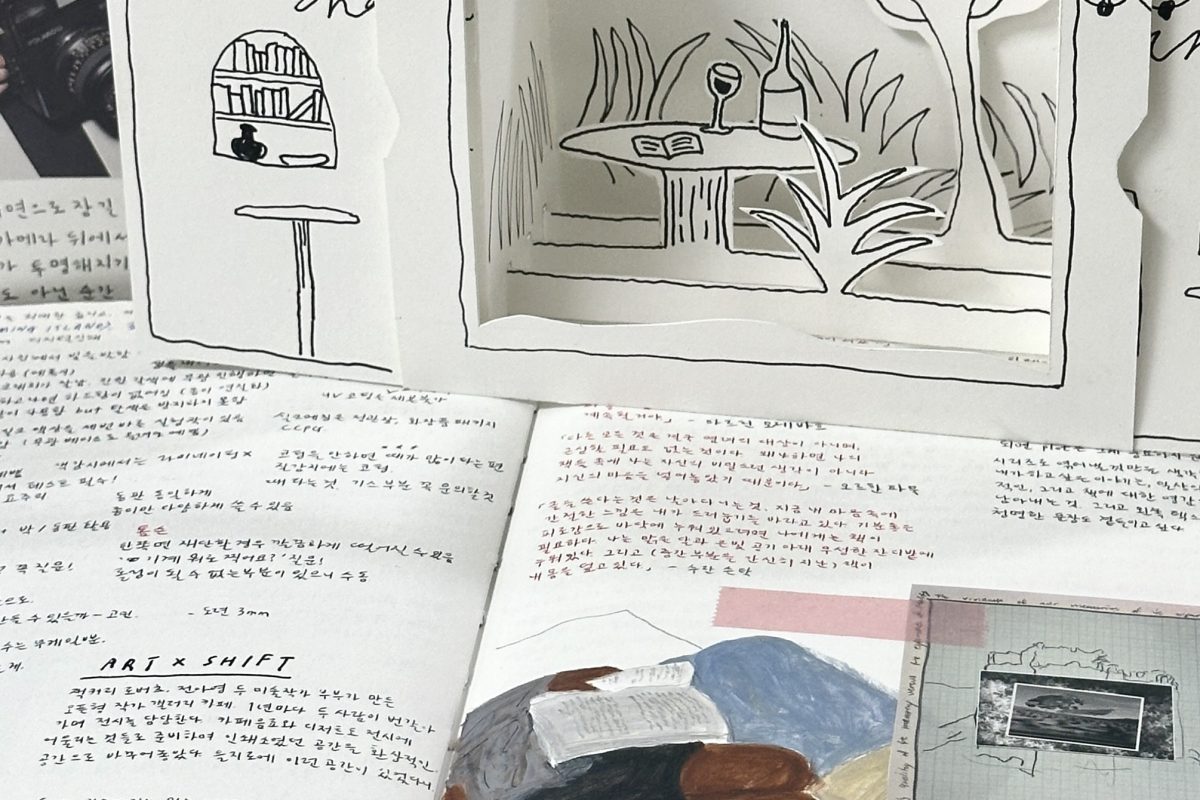
    For the past year, I have been filling my journals with the mindset of ‘publishing’ them. I use letters and images cut from printed materials, along with my own handwriting, drawings, masking tape, and stickers. The process feels much like recording an improvisation exactly as it unfolds. Rather than starting with an elegant plan for the layout, I let my hands move first, leaving the rhythm of the day on the page. It feels as though I am editing, little by little and in real time, a magazine about my own life. When the first edition began to take shape, I also started scanning and sharing it publicly, two pages at a time.

    By the time I finished the first edition, fifteen days had passed since my mother’s death. There was still about ten percent of the notebook left to fill, but for the next two months, I could not write in my journal at all.

    Then one day, while wandering through a bookstore, I came across a notebook that immediately drew me in. It belonged to the Notizbuch series by Insel-Bücherei. It was smaller than the journal I had brought from Korea and nearly five times more expensive, but I loved its design, which closely resembled the hardcover Insel-Bücherei books I had always admired. It also seemed like the kind of notebook I could continue to collect in the same format, one volume after another, rather than something that would end with a single book. The new notebook gave me enough energy to begin writing again at the end of April. I tried to pick up the rhythm that had been interrupted. Each time I opened it, I felt as though I were writing a book of my own, and that feeling helped me sink more deeply into the pages.

    Before I made a conscious decision to write journals that could one day be shown to others, I had already exhibited one of my journals at a small book fair in Korea. I was there to introduce Private Paradise, my first independently published book, which was based on my diary entries. I brought the original journal with me, thinking it might lend the book a stronger sense of truth. Visitors to the booth were drawn not only to the book, but also to the journal itself. I watched with interest as they turned its pages carefully, with a mixture of quiet curiosity and the faint guilt that comes from looking into someone else’s diary.

    Later, when I created SAPA (Stacked and Piled Attempts), an art book series, I left one of my journals at a bookstore for nearly a month as part of an exhibition. I had shown my photographs in exhibitions several times before, but this was the first time my journal had remained in a space without me. It frightened me a little to make such private records available to strangers. Still, the journal was from several years earlier, and the most important passages had already been written in a secret language I had invented when I was seventeen. That distance made it easier to let the journal stay there.

    After coming to Germany, I had a similar experience. To the people I met here, my journals seemed to be mysterious objects in their own right. Whenever I showed one to someone, they would linger over each page for a long time, almost as if they were looking at a painting, even though most of the words were written in Korean. It felt strange and quietly moving to realize that even when the language could not be read, people still approached someone else’s diary with care.

    Each time I placed my journals before others, I began to understand something. A journal may serve as a record of daily life, but for me, it is also the work of art I have sustained longer than anything else in my life. Just as a painting on canvas can be an artist’s language, or a novel can be a writer’s, the journal has become the form through which I hold time and express my world.

    The rhythm of handwriting, collages made from cut paper, photographs and drawings, notes and empty spaces ⎯ all of these elements were becoming a visual language of their own, reaching people before the written content could. Once I realized that a journal could draw a response similar to the one people have before a work of art, I decided to bring my journals into the world more deliberately. I began to think of them not as daily notes, but as art books completed one page at a time.

    Recently, I had the opportunity to exhibit the first edition of my journal alongside photographs and notes in a festival space. People who could not read Korean still lingered in front of the pages. Some looked carefully at the drawings; others examined the collaged fragments; some searched through page after page, looking for the occasional German sentence scattered among the Korean. Watching them, I felt once again that what I had been creating all this time was not merely a journal, but a visual work built from layers of writing, images, and time.

    I do not want my journals to remain merely tools for recording the day. They will continue to be the starting point of my work, and perhaps the medium I will stay with the longest. Alongside the ongoing archive of the original journals, I hope to create new books from those records. Some pages will remain as they are, while others will be gathered into essays and art books, becoming works of their own. A record does not end; it continues to grow into other forms.

    What I want to make is not a single book. It is a world formed slowly over time, as the records born from one person’s life connect, expand, and begin to belong to one another. The first page has already been opened. There is only one thing left for me to do: complete today’s page, and tomorrow, open the next. In this way, over a long stretch of time, I will continue publishing the life of one person.

    *Reading in other languages:

    *Continue reading:

  • In the Midst of a Miracle

    In the Midst of a Miracle

    There are times, amid the repetition of ordinary days, when we find ourselves wishing for something extraordinary to happen. Something that might change our lives all at once. Winning the lottery. Finally solving a problem that has weighed on us for years. Moments like these are rare. But stretch that single extraordinary moment across time, and before long it becomes indistinguishable from ordinary life itself, like a rainbow whose edges have faded until they disappear into the sky. Perhaps we move through miracles every day without recognizing them for what they are.

    My father came to Germany after completing the 33-day Camino de Santiago pilgrimage. It was his first time visiting the city where I now live, and I wanted to fill his stay with memories worth keeping. One of them was a trip to the Dolomities, a place he had dreamed of hiking for decades.

    I’m not someone who enjoys traveling with a carefully planned itinerary. I much prefer leaving room for adventure, following whatever unexpected discoveries the day happens to offer. But this wasn’t just another trip. I felt responsible for making it a meaningful one for my father. Whenever I found a spare moment, I caught myself studying maps, comparing routes, and looking for a better trail than the one I’d found the day before.

    Traveling has always been one of my greatest joys. Packing for it, however, remains one of my greatest miseries. Every trip begins with the same impossible puzzle: how to keep my bag as light as possible while somehow making room for everything I might need. I finally finished packing at two in the morning and left for Munich Central Station a few hours later.

    Then, from the very first train, everything began to unravel. Delays rippled through the schedule, one reservation collapsed after another, and only after setting off did I realize that I had brought my German residence card but had absentmindedly switched bags at the last minute, leaving my passport behind. After a brief moment of panic, I did the only thing I could. I Improvised. Friends rushed to Munich with my passport, and somehow I managed to board the last direct train to Brennero just ten seconds before the doors closed. Ironically, had that train arrived on time, I would have missed it entirely.

    By the time we had changed trains, boarded another bus, and finally reached our accommodation, it was nearly nine in the evening. Rain was still falling in steady sheets. We had spent almost twelve hours simply getting there. A full day of a four-day trip gone before it had really begun.

    I was one the verge of panic, but my father kept reassuring me. “It’s alright,” he said. “It’s no big deal.” I felt terribly guilty. He was the one who had endured the exhausting journey, yet he was the one comforting me. There was no point dwelling on everything that had already gone wrong. All we could do was make the most of the time we still had.

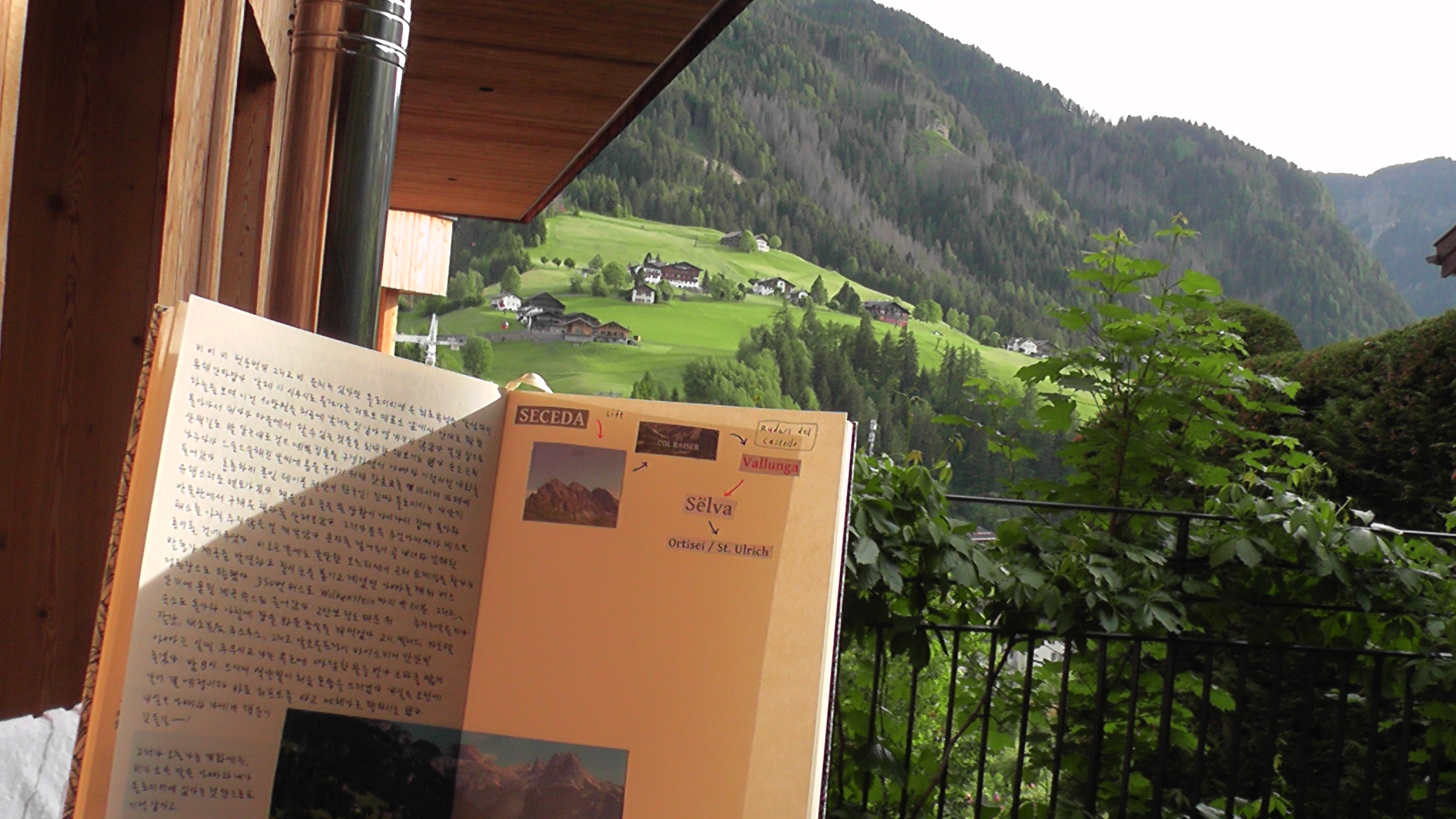
    That night, after my father had gone to bed, the rain grew heavier. I switched on a single lamp and opened the book and journal I had brought with me. The forecast promised another fully day of rain, and I couldn’t help feeling a little disappointed. Yet the moment I opened my book, something inside me softened. In a town I had never been to before, reading and writing with the sound of rain outside felt like a small luxury.

    The forecast turned out to be exactly right. It rained without pause the entire next day. We wandered through the village, visited a small museum, and made our way along the Vallunga Valley, where the lower elevation spared us from the worst of the weather. That evening we cooked dinner together. While my father enjoyed a quiet soak in the bathtub, I opened my journal once again. I slowly replayed the conversations we had shared throughout the day, then ended the entry with a single sentence.

    “Rain or shine, simply being here with my father feels like a miracle.”

    On our last day in the Dolomities, the rain stopped as if it had never existed. The storm from the day before had left a generous layer of snow high in the mountains, laying an unexpected veil of winter over the middle of summer. We walked for as long as our legs were willing to carry us. then returned to the apartment in the late afternoon.

    Before dinner, my father lay down for a short nap while I took a shower. With my hair still damp, I settled onto the balcony with my journal and a book. Two hours slipped by almost unnoticed. Sunlight, a gentle breeze, and birdsong were all the soundtrack I needed. I spent the rest of the afternoon cutting up the free travel brochures I’d collected, turning them into small collages, and lingering in the luxury of an unhurried day.

    No matter what life brings, keeping a journal enriches the time I have been given. Most days, I simply write about how I managed to make it to the end of another day. But when I return to those pages months or years later, that ordinary day reveals itself in an entirely different light, becoming part of a much larger landscape.

    My father returned to South Korea a month ago. While writing this essay, I opened the journal I kept in the Dolomities. Looking back now, I realize that simply sharing those days with him was a miracle. Not only on the bright, sunlit afternoons, but also on the days when rain poured relentlessly, on the days we mourned my mother, and in all the quiet moments when we leaned on each other and carried one another through.

    Miracles whose outlines were too faint to recognize at the time.

    So today, I continue to place both despair and joy into my journal, hoping that one day my future self will return to these pages and discover that this ordinary day, too, was beautiful in the way miracles often are. Looking back, it feels astonishing enough that I was given the chance to live through those moments at all. Perhaps, even now, we are walking through the midst of a miracle.

    *Reading in other languages:

    *Continue reading:

  • Catching My Breath

    Catching My Breath

    “Why do you keep a diary?”

    It’s a question I’ve been asked countless times, perhaps because I carry a notebook with me wherever I go. For years, I never knew quite how to answer it. The question always felt strangely similar to asking, “Why do you breathe?” or “Why do you eat?”

    I’ve been filling notebooks for more than thirty years. Somewhere along the way, the years quietly accumulated, and keeping a diary became as instinctive as walking. It is no longer something I consciously choose to do. It’s simply part of how I move through life.

    My first diary was a picture diary, which I began when I was five years old. Back then, it was enough to write a few simple sentences about what I had done, where I had been, and who I had spent the day with, alongside clumsy little drawings. Each completed sketchbook brought with it a quiet sense of accomplishment.

    As the years passed, the drawings gradually gave way to words. Sketchbooks became notebooks, and once I was in school, each entry began with my schedule for the day.

    But the greatest change wasn’t the length of what I wrote. It was what I chose to record. At some point, I stopped writing only about what had happened and began writing about what had happened within me. There were days when a single page wasn’t enough to understand why I felt the way I did, or what had unsettled me so deeply.

    That was when my diaries began to grow longer.

    Around the age of twenty, I found myself asking more and more questions about life. How should I live? Why was I the way I was? Whenever those questions became too loud to ignore, I wandered the shelves of the library in search of books, hoping to find the wisdom I needed most at that moment.

    Every now and then, I would come across a sentence that felt like rain on parched ground. I couldn’t bear to leave it behind. I copied it into my diary, and beside it, I wrote down whatever thoughts it stirred in me. Little by little, my diary stopped being a record of the day and became a place where I could have a conversation with life itself. Each time I wrote, my breathing seemed to grow just a little deeper.

    Thoughts and emotions that were once too difficult to bring into the open gradually took shape on the page. They met the words I had gathered from books, mingled with my own reflections, and slowly became clearer. Whenever I poured them onto paper, I found myself left with just enough breath to carry me into another day.

    That is how my diary quietly became my oxygen mask. It never breathed for me. It simply helped me find my own breath again. If someone were to ask me why I have kept a diary for so many years, I think my answer would be simple. To keep breathing.

    Keeping a diary is a wild garden that asks for nothing more than a notebook and a pen. It is a place where things are free to grow as they will. Unexpected flowers bloom. Sometimes there is nothing but weeds. At other times, I find myself observing an unfamiliar insect that has wandered in from somewhere beyond the page. It has never needed to be perfect to become the place where I feel most at ease. And so I will keep wandering through that garden, slowly, preserving each passing moment along the way.

    *Reading in other languages:

    *Continue reading:

  • Where Paradise Remains

    Where Paradise Remains

    Where do we keep our paradise? There was a time when I believed mine existed in the hours I shared with someone else.

    Then, one day, the person I was seeing disappeared. Without a word. He vanished not only from my life, but from everyone else’s as well, as though he had stepped out of the world. At first, I assumed something urgent had happened. Three days passed. A month later, I began to wonder if he had been in an accident. The seasons changed, and before long, a year had passed.

    There was little I could do except throw myself into my studies. Somewhere along the way, I forgot how to smile. By the end of the year, even when I was surrounded by other people, smiling no longer came naturally.

    It was nearly two years later that I finally heard what had become of him. He had moved to another part of the country and was taking part in a program centered on self-discovery. It seemed he, too, had been trying to find a way through the uncertainty of the future, stumbling, searching, and eventually making his way forward in their own way.

    Disappearing without a word. The most direct rejection and loss I had ever known. A fog with no clear origin and no visible horizon. I couldn’t see what had caused it, nor where it would lead. No matter how desperately I tried to sweep it away, the fog refused to lift. There was nothing I could do except remain inside it.

    Growing up as an only child, I came to think of the time I shared with someone outside my family as a kind of paradise. Before long, being together began to carry more meaning than it should have. But when that person disappeared, the paradise I had so carefully built vanished with them. That was when I realized that paradise could not be something I placed outside myself. It had to be something I built within. That is where the name Private Paradise was born.

    There are always moments in everyday life that allow us to lose ourselves, if only for a while. For me, writing and photography became the ways back. Writing became the hand that reached through the fog. When words could no longer carry what I felt, those feelings found their way into drawings instead. And whenever I came across a place I knew I would one day want to return to and rest within, I kept it in a photograph. I loved the silence that came with standing behind the camera. Over time, those fragments became my first exhibition in 2015. A few years later, they became a book. The project continues to grow today, taking on new forms with each passing year.

    I want to build a life I can lose myself in. A life with its own rhythm. One where everyday life and creative work flow naturally into each other, allowing me to move through the world in step with my own breath. I have come to cherish that ongoing process of searching, questioning, and finding my way. It brings me joy to know that my paradise does not wait at the end of the journey, but exists in every moment of deep absorption along the way. There was a time when I believed paradise could only exist with someone else. Now I know that the paradise I have cultivated within myself is one that can never be lost.

    *Read in other languages:

    *Continue reading:

  • Ready for Chance

    Ready for Chance

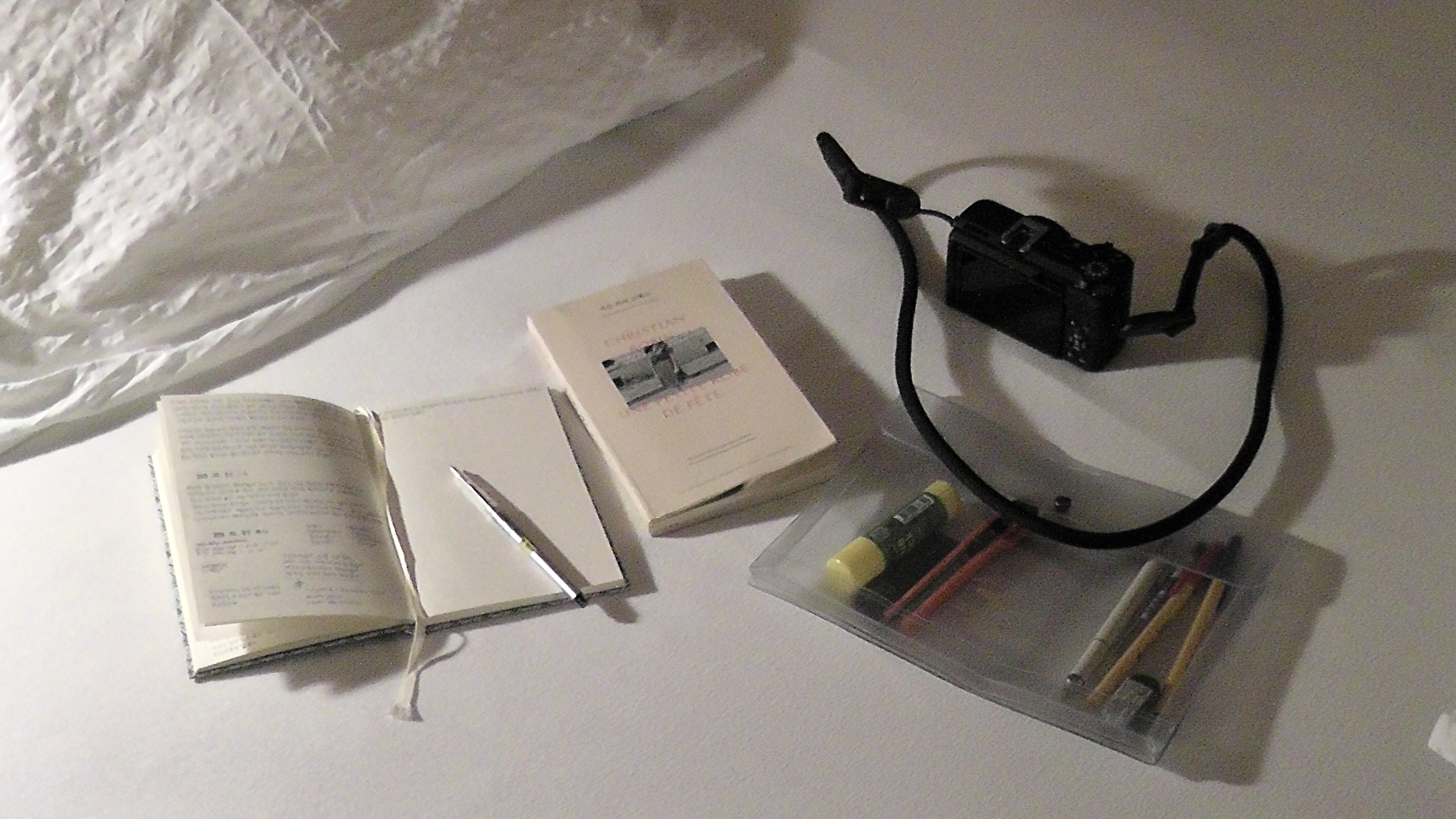
    Pack mule. Donkey. Those were the nicknames I gradually picked up because my bag was always so heavy. I don’t carry makeup, but I never leave home without a journal, pens, a camera, and a book. Once I start adding extra lenses, even my shoulder bag becomes almost too heavy to carry. People could be forgiven for wondering if I had a hammer hidden inside. After fifteen years of carrying it everywhere, even my shoulders and spine have slowly begun to take on its weight.

    I don’t particularly enjoy carrying such a heavy bag. On days when I have to walk for hours, or when the summer heat makes even standing still exhausting, it feels like a cross I’ve chosen to carry. Yet after fifteen years, I’ve come to realize something: if I don’t have those things with me when the right moment arrives, I regret it far more than the weight itself. Somewhere along the way, one belief became a guiding principle in my life: you never know what moment is about the unfold.

    Of course, it’s impossible to carry every tool I might need. Instead of bringing less, I’ve tried to make each item lighter. What I pack depends on where the day is taking me. For important projects, I carry my Fujifilm X-Pro2 along with a selection of lenses. For everyday life, I usually bring my Canon V1. And on days built around cycling, swimming, or other outdoor activities, I reach for my tiny but remarkably capable Olympus TG-830.

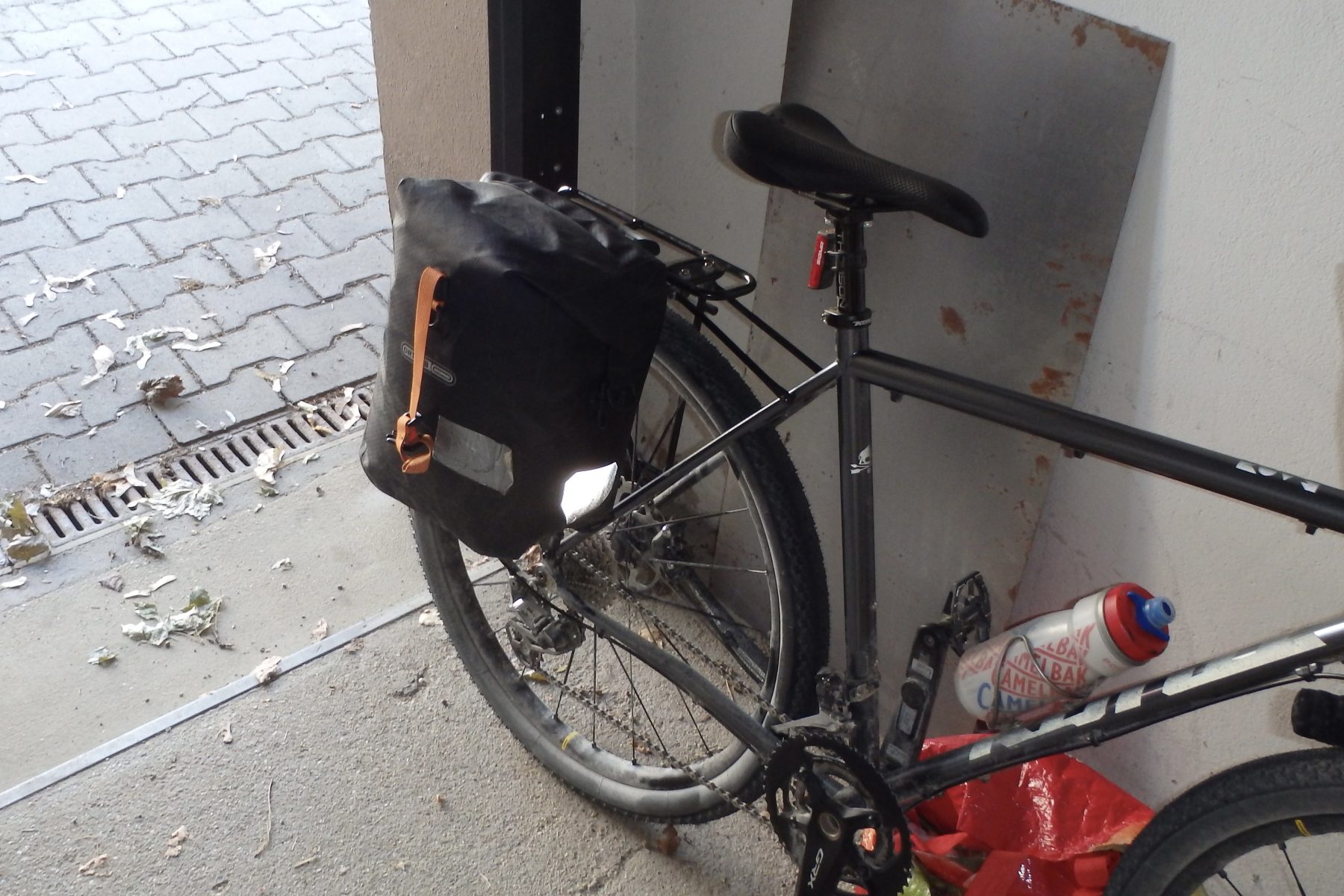
    It was a Saturday morning. Marco and I decided to take bicycles out for the first time in weeks and ride down to the river for a swim. But as I packed one thing after another, my bag grew heavier by the minute. Marco is the complete opposite of me ⎯ he moves through the world lightly, carrying only what he needs. As I stood there wondering what I could leave behind, I suddenly remembered the pannier bags hanging from his bicycle when we first met in South Korea. They had travelled all across Korea and Japan before quietly retiring to our wardrobe, where they had been waiting all this time.

    I transferred everything into the pannier bag and headed down to the garage. After installing a rear rack on the bike, Marco clipped the bag into place. They were still pleasantly heavy, but when I took the bike for a short test ride, they hardly affected the ride at all. It felt as though something that had been sitting heavily inside me for years had finally lifted. I wondered if this was what people had felt when they first learned to load their belongings onto the back of a camel. I could bring almost everything I wanted without carrying the weight on my shoulder. Riding away with my back free felt entirely different from simply tossing a bag onto the passenger seat of a car.

    When we arrived at the Danube, I unpacked my outdoor mat, journal, pens, and books from the pannier bag. There was even room for the book Marco had brought along. Now I could go anywhere without having to leave anything important behind. After our swim, we lay on the mat and spent some time reading together. Then I sat up and finished writing in my journal. It made me unexpectedly happy to realize that I no longer had to scale down the way I wanted to live and record the world. A simple pannier bag had made far more than my luggage feel lighter. I think I’ll always choose to adapt my surroundings rather than give up the life I want to record.

    *Read in other languages:

    *Continue reading:

  • Putting Down Aerial Roots

    Putting Down Aerial Roots

    A plane leaves the runway, only to be forced back by fierce crosswinds at its destination. It circles overhead, attempting to land again and again, yet never quite makes it to the ground. If I were to stretch the comparison, that plane would not be so different from where I found myself over the past year.

    Moving to another country feels a little like rebuilding the stage of a play from the ground up, replacing every last piece of the set. As I carried a mountain of a life 9,000 kilometers from South Korea to Germany, my everyday life seemed to lose the ground beneath it, suspended somewhere in midair. Two weddings ⎯ one in summer, the other in winter ⎯ would have been enough on their own. Then my mother’s pneumonia took an unexpected turn, followed by the unimaginable reality of her funeral. Somehow, I held together a mind that kept slipping through my hands, and found myself standing in another summer.

    Last July, I arrived in Germany and got married. In November, we held another wedding in Korea. From December through February, I lived through the slow loss of my mother. In March, I returned to Germany and began putting the practical pieces of life here into place. More recently, my father’s first month-long visit to Germany came to an end, and I made my way through the final week of June under an unforgiving heatwave. By the time another July arrived, a full year had quietly passed.

    More than anything, I wanted to put down roots. Yet I found it difficult to hold my mind still long enough to lose myself in anything. On the days when my spirits sank, one phrase kept appearing in my journal: neither here nor there. I longed to retreat into myself, to search for an answer, and to return with it.

    After nearly a year, anxiety and frustration began to burn through me like a torch. Before that longing could splinter, it was finally time to do what my soul and unconscious had been asking of me all along. I lowered my fingers onto the typewriter like aerial roots reaching for the earth. A life at a desk can be every bit as alive as one on a festival dance floor.

    Before a plant can put down roots, it first needs soil. For people, roots begin with a sense of stability. That quiet steadiness grows out of physical strength and the repetition of everyday life. The structure of daily living and the framework of one’s work become the ground beneath our feet. From there, I hope my life will continue to take on unexpected forms through chance encounters, unforeseen turns, and all the small accidents in between.

    Is there a way to belong to Germany and Korea at the same time, or perhaps to anywhere else as well? Whatever work I end up doing, I want to build a life that offers as much stability and as much freedom to move as possible. I want to become a tree that can carry a piece of the earth it has rooted itself in, wherever it goes.

    A new life begins to reveal its fresh body. <Who are you?>, <What kind of person are you?> These are the questions people keep asking me here. In this unfamiliar world, even the parts of myself that had become so natural I never thought to explain them seem to have been reset, down to the smallest corners.

    What expression will I wear? What clothes will I choose? What role will I step into? All of it is mine to decide. Here, I can shape my identity however I wish, or refine it into something even more precise. Standing before this overwhelming blank space, I find myself asking one question: What qualities do I want to fill it with?

    *Read in other languages:

    *Continue reading: