
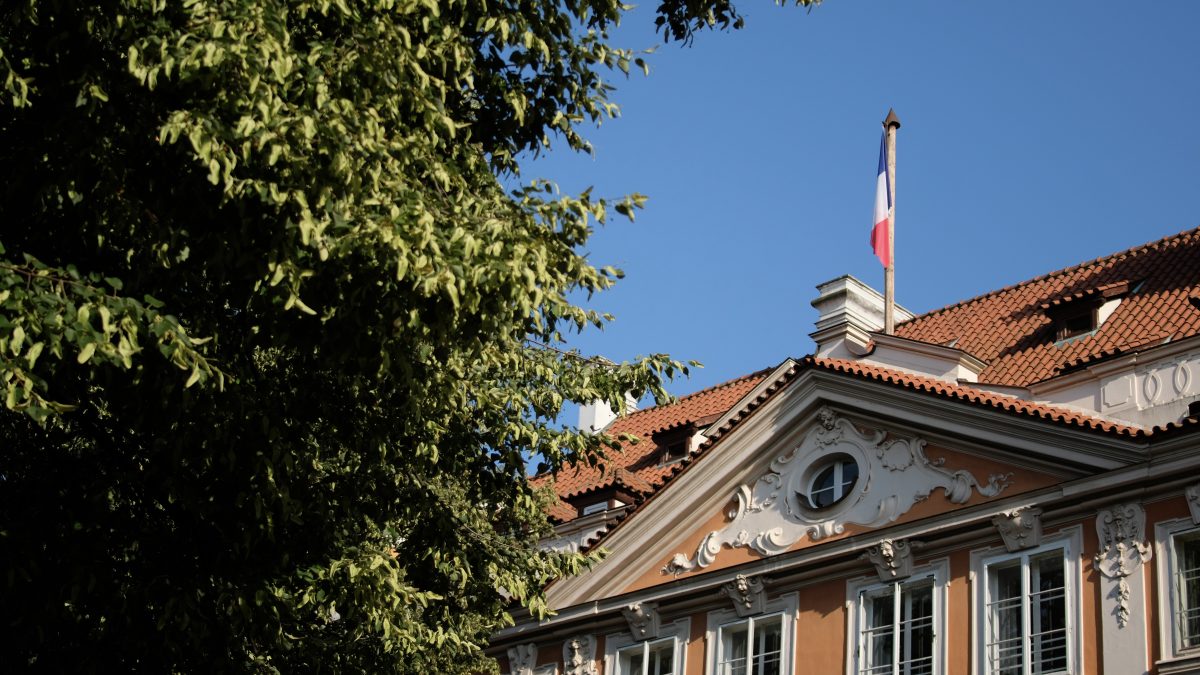
From where I live now, Prague is surprisingly close – just one border away. Kafka’s city. I had long wanted to visit the place I had heard so much about, yet somehow, whenever I thought I might finally have the time, something else would slip into the calendar.
Then, as summer approached, I heard about Christopher Nolan’s The Odyssey. The nearest cinema where we could experience it in analog IMAX 70mm was in Prague. It felt like a sign that the time had finally come. The film was already so popular that, even a month before the screening, nearly all the good seats were gone. I clicked through the dates until I found two seats left of center for a Sunday matinee and booked them immediately. If we were going all that way, I thought, we might as well arrive the day before and spend a little time wandering through the city.
We held off booking our hotel until a week before departure, almost as if making too many arrangements in advance might somehow tempt fate and cause the whole trip to fall through. And so we set out on a small odyssey of our own: crossing a border for the sake of a single film.
On a Saturday morning in July, we boarded a bus bound for Prague. Sitting on the upper deck and watching the landscape pass outside the window, I felt as though we were aboard a large ship, drifting towards an island called Prague. I opened Google Maps and saved our hotel and the train station, along with a handful of cafes, bookshops, galleries, and museums. I had no intention of trying to see them all in two days. Still, rather than setting off knowing nothing at all, we like to glance over a map first and then let ourselves drift towards whatever chance and coincidence happen to place in our path.
After three and a half hours sailing across a sea of asphalt, we arrived at Prague’s main station. It was a thirty-minute walk to our hotel. My backpack was fairly heavy, but knowing we would leave the city again tomorrow made me want to take as many steps as I could.
This time, I had brought a proper camera with me too. Lately I had been traveling with little more than a compact camera, but for this trip I mounted a 28-135mm Canon lens, a gift from Marco’s uncle, onto my Fujifilm camera for the first time. Drawing a fleeting moment in an unfamiliar city closer, then studying it through the viewfinder – this was a pleasure I had almost forgotten.
There was a time when I travelled with three prime lenses dangling from my bag. But this journey was short. I wanted to spend less time changing lenses, and less time standing alone in one place for the sake of a single photograph. When you travel with someone, your stopping also brings their time to a halt. This time, I wanted, as much as possible, to keep walking together – to look at the same things together, and somehow make photographs along the way.
The First Taste of Prague
Even though we live in a country famous for beer, we hardly drink at all in everyday life. Germany also has a wide range of good non-alcoholic beers, which makes abstaining fairly easy. If anything, this kind of routine makes the occasions when we do drink feel more worthwhile. When a good enough reason presents itself, we can loosen the lock without much guilt. The Czech Republic is said to have the highest beer consumption per capita in the world, so we decided to go with the flow.
Our first stop was Naše maso, a butcher shop and restaurant recommended by our German friend. On the way to our hotel, we stopped there for lunch. Apparently, we were far from the only ones who had heard of it. A long line of tourists had formed in front of the ordering kiosk. Eventually, we found a place to sit and set down a freshly made burger and a beer poured straight from the tap next to us. Meat, for us, is a little like alcohol. We try to eat as little of it as possible in ordinary life, but neither of us is quite willing to give up the place that good food occupies in our lives. So when we travel, we occasionally let the rules loosen. On an empty stomach, I bit into the juicy burger and took a long drink of the rich, malty beer. Somewhere inside us, the meat and beer began dancing an enthusiastic polka.
Properly fueled with an unreasonable amount of calories, we made our way through the medieval lanes of the Old Town and crossed Charles Bridge. We reached our hotel just in time for the three o’clock check-in. Our room was small and cosy, with a window overlooking the street. We dropped our backpacks and headed straight back outside. As we walked, we kept seeing stalls selling chimney-shaped pastries called trdelník. I had imagined something roughly the size of a croissant, but once topped with ice cream, ours looked more like a small torch. One would easily have been enough to share. Instead, we each carried an enormous trdelník through the streets like medieval townspeople bearing torches. I did my best, but I couldn’t finish. In the end, I surrendered what was left to the bees, who had been circling eagerly around the sugar. Our first meal and first dessert very nearly became our last food of the day. There was nothing left to do but keep walking.
Two Books Found by Chance
After leaving the crowds behind, we wandered through the quieter streets of Malá Strana, where an inviting bookshop appeared in front of us. It was Shakespeare and Sons, one of the places I had saved on the map. I had not gone looking for it, yet somehow the place I had been most excited to visit seemed to find me first.
Inside, the rooms felt as though someone had taken an old house and turned its living room and kitchen entirely into bookshelves. Whether it is a cafe, a bookshop, or a museum, I am more easily drawn to places that feel like a home someone once lived in for years than to spaces polished into sleek perfection.
Downstairs, even more books waited: art, photography, architecture, comics, and countless other subjects. Warm pools of lamplight fell over readers sunk into books on single armchairs. There were worn sofas with frayed edges and tables buried beneath stacks that seemed ready to burst. Half a day would hardly have felt enough.
Among the shelves, I found John Berger’s The Moment of Cubism (Verso, 2026) and Hans Ulrich Obrist’s Ways of Curating (Penguin Books, 2015). I wanted to understand Prague’s Cubism a little better, and books about ways of seeing and ways of choosing felt as though they might leave something behind in my own work as well. Together they cost 898 Czech koruna, about 37 euros – enough for a generous meal for two. Still, these were texts I genuinely wanted to study, and buying them also felt like a small way of supporting a bookshop I hoped would continue to exist. I even loved the yellow bookmark tucked in with them.
We had only one day in Prague. I reluctantly folded away the wish to stay longer, slipped the two white-covered books carefully into my bag, and stepped back outside. Looking back, I am glad I bought them, even if it felt slightly extravagant at the time.
An Evening That Passed Through Four Seasons
By the time our enthusiastic walking carried us into the evening, I was ready to sit down almost anywhere. Perhaps because of the enormous trdelník, I was not particularly hungry. A beer or two seemed enough.
That was when Pivovar U Medvídků caught my eye. We decided to place a little trust in the weight of the number 1466. Over the centuries, the building had passed through many lives: brewery, beer hall, cabaret, a period of state ownership under socialism, and eventually a return to its original owners. Its brewing tradition, interrupted for a time, was revived around 2004 with the opening of a small in-house brewery.
Choosing just one beer felt like a missed opportunity, so we ordered a tasting flight. Four small glasses soon appeared in a neat row across the table. The first two were crisp and lively. The next two grew darker, deeper, and heavier. It felt like moving from spring into summer, then crossing over into autumn and winter.
We made a game of it. With each sip, we had to call out a word connected to that season at exactly the same time. Some came from memories we had made together; others were odd little associations that surfaced without warning. We said them all without hesitation. Just before the final sip of the winter beer, my last contribution was: “Der Arbeit is Schnee!” (Work is piling up like snow!) Four seasons had passed through us in the space of a few glasses, and the alcohol caught up with us quickly.
Charles Strickland’s Final Mural
Prague after dark felt like a different city. It was our first night there, and at the same time our last. We gathered what energy we had left and decided to keep exploring.
By then, we were becoming increasingly fond of Prague’s beer. While walking, we came across a crowded bar called IV Bar. I ordered a Budvar 33, which arrived in a squat, round-beliied half-litre glass known as a pulitr. It was a pale lager, but the bitterness came through with surprising clarity.
On one wall was a mural dense with tropical plants. Looking at it under the dim lights, I thought of Somerset Maugham’s The Moon and Sixpence – of Charles Strickland in Tahiti, finishing his final mural as his body deteriorated around him. The painting in front of me was, of course, nothing like the one in the novel. But with alcohol beginning to soften the edges of my thoughts, the resemblance did not need to be exact. It was enough to set the imagination in motion. I also wondered about the lush palm-leaf backdrop used in the photography studio where Kafka was said to have been photographed as a child. Could it have looked anything like this?
We sat facing the mural, drinking our beer and talking about where we might travel that winter. I can hardly imagine a better place for letting plans and ideas begin to take shape.
An Old Study and One Last Beer
On our final walk, I noticed a room across the street lined with shelves of old books. At first, I thought it might be a small library, but when I moved closer, I realized it was a bar: Cafe Club Míšeňská. A bar full of books was not something I could simply walk past. There were only about thirty minutes left before closing, but we decided to have our final beer there. We took a seat on a sofa near the exit. Vintage furniture, plants, and books filled the room in a loose, lived-in arrangement.
I set my beer beside an old typewriter and began pulling Czech books from the shelves, one by one. I could not read a single sentence, but that hardly mattered. Touching the aged paper, looking at the type, and studying the way the books had been bound was pleasure enough.
After the trip, I looked into the history of the building. It had once housed an apiary and, for many years under the ownership of a single family, was used to make soap and perfume. Since 2016, it has operated as a cafe, while the cellar has become a small club for concerts and performances – a kind of salon that continues to bring together local culture and people. It seemed I would leave Prague without ever properly meeting Kafka. That was all right. Instead of tracing Franz Kafka’s footsteps, I had been gathering fragments of literary atmosphere from all over the city. If I return to Prague, I would like to come back to Míšeňská in daylight. Next time, I think I will order coffee instead of beer.
A Quiet Morning
Thankfully, there was no hangover. I woke in the warmth and stillness of the room, slipped carefully out from under the rustling duvet, and took a sip of water. Then I gathered the two books I had bought the day before, along with my journal, and sat by the window. The street was still quiet. Every now and then, a single car passed below.
When traveling with someone, time alone to read and write feels especially precious. Reading and writing, after all, are acts that only become fully meaningful when one is entirely alone. I thought I might have thirty minutes, perhaps an hour at most. Curled up by the open window with the breeze coming in, I turned to the first page of one of the books. After a few pages, a sentence I wanted to write suddenly came to me, so I opened my journal instead.
It was only a brief record of the day before, a way of retracing the route we had taken. When I finished and read it back, I noticed that the longest passages were about two things: the pleasure of properly taking photographs with a camera again, and the story of finding a bookshop by chance and leaving with two books.
Perhaps there is no getting around it. Images and words have always been my oldest sources. I closed the journal and packed the books back into my bag.
We checked out of the hotel and stepped back into the city with our heavy backpacks. After crossing Charles Bridge and turning into the interior of a building, we came upon a small courtyard. Centuries ago, the space had formed part of a complex belonging to the Order of Malta. Today, it is home to L4 Cafe. Buildings enclosed the courtyard on every side, yet the sky remained open above us. It was outside and inside at once, with the noise of the city softened by a thin layer of distance. We began our Prague morning there with cappuccino and cake.
An Odyssey on Film
Cinema City Flora, where the film was being screened, lies to the east of the city center. The tram ride took a little over thirty minutes. Through the rectangular frame of the window, Prague kept appearing and disappearing: buildings, people, rows of trees along the street. After a simple lunch at the shopping center, we entered the cinema at last.
We passed through waves of red seats and sat down before an IMAX 70mm screen unlike any I had seen before. My gaze had traveled from the camera’s viewfinder to the pages of my journal, then to the square of sky framed by the buildings around the courtyard. Now it arrived at the final destination of the journey: this enormous screen. Light passed through the great strips of film, frame by frame, releasing extraordinary images across a screen that seemed to open in every direction. If the screens I had known until then had been looking at the world through narrowed eyes, 70mm felt like seeing with them fully open, revealing details that had always been there but somehow remained hidden.
We followed Odysseus as fragments of memory returned to him on Calypso’s island of Ogygia, and traveled with him through the long passage home. I was completely take by James Blake’s voice, which became one of the defining sounds of the film’s score. When the film ended and we rode the escalator down, Marco handed me one side of his earphones. We listened to the closing song, “When I’m Home,” on repeat while talking through what we had just seen. There were still about four hours before our bus home. So we headed towards the Dancing House by the Vltava and took one last walk through Prague on our way back to the main station.
On the evening bus back to Regensburg, I looked up from one of the books I had just bought and gazed out the window. Only one night in Prague. We had not made it to any of the galleries or museums I had saved on Google Maps, and yet I was struck by how much artistic time had found us in brief, accidental encounters: the treasures in the basement of the bookshop, four small beers passing through the seasons, a bar filled with books, my journal open by the hotel window, and those breathtaking landscapes unfolding across 70mm film.
Thankfully, our journey home was much shorter than Odysseus’s. Still caught in the momentum of the trip, I stayed up until two in the morning, noisily throwing myself into one subject after another before finally falling asleep. For someone who dreams of a life covered in books and art, the scenes I had seen in Prague kept whispering the same thing to me. That life exists. So come back. Come back once more, and let yourself be completely carried away by the dream.
*Reading in other languages:
Leave a Reply