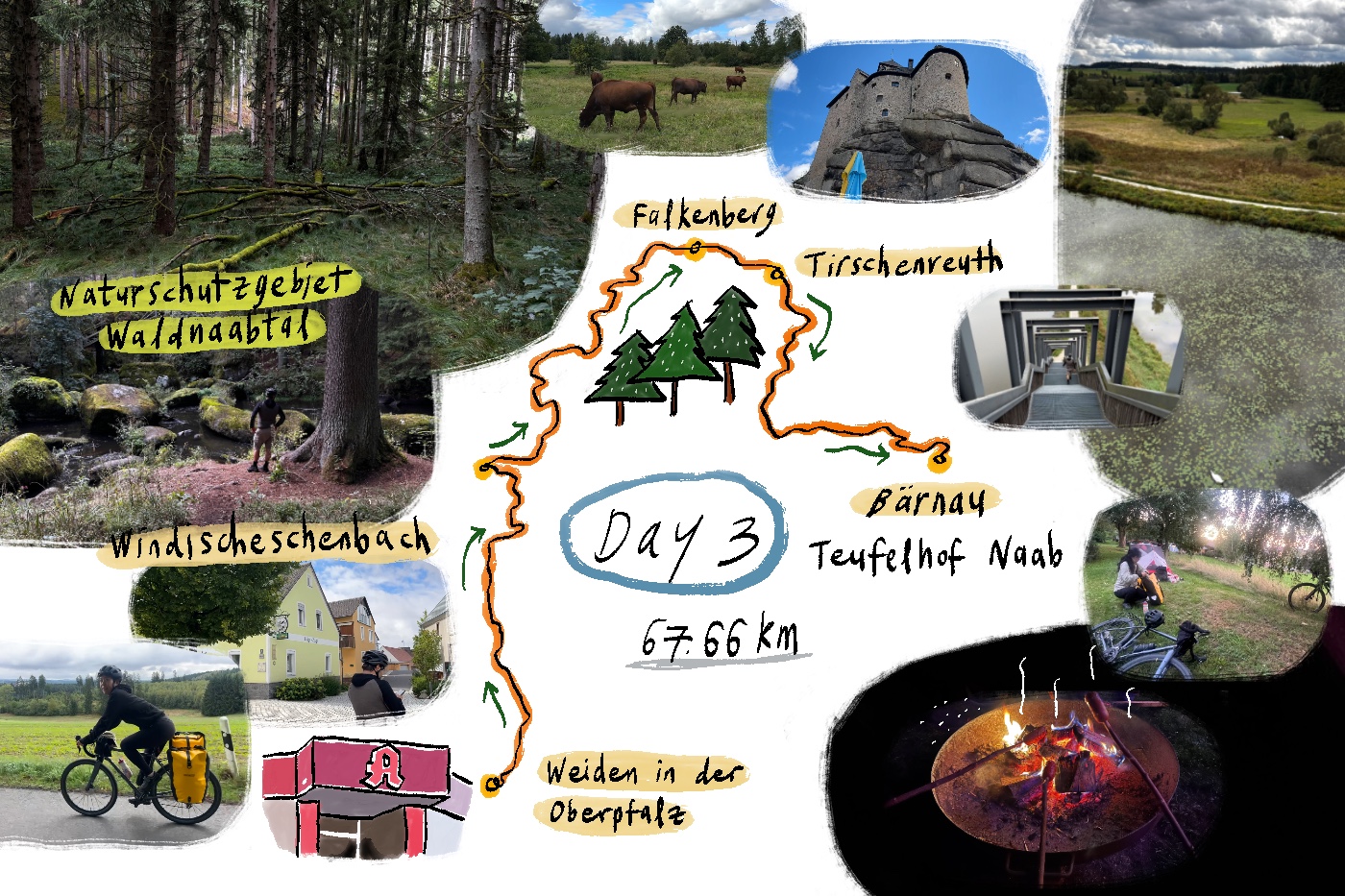
67.66 km through Waldnaabtal, Falkenberg, Tirschenreuth, and the campsite in Naab, Oberpfalz
By nine in the morning, we had finished packing before heading down for breakfast at the hotel. The tent and clothes we had hung up in the bathroom the night before were completely dry. Even the €15 breakfast buffet exceeded our expectations. It was the kind of morning when everything seemed to be falling into place.
But there was one problem. Every time I swallowed, I felt a sharp, unsettling sensation deep in my throat. Perhaps cycling through the rain all day yesterday had taken more out of me than I thought. If my tonsils started swelling, a fever would probably follow, along with the familiar aches of being properly ill.
I sipped warm tea to soothe my throat and considered my options.
Should I end the journey here, or keep going?
Marco told me not to push myself. If I wasn’t feeling well, we could always take the train home. But I couldn’t bring myself to end the trip just yet. We decided to stop at a nearby pharmacy, buy some medicine, and continue as far as the next town with a railway station. Once there, I would see how I felt and make a decision.
At the pharmacy, I bought neo-angin, isla cassis throat lozenges, and a gargle solution. I wasn’t particularly happy about the unexpected €33 expense, but as time passed, I was surprised to find myself feeling considerably better.
Eventually, we reached Windischeschenbach, a town with a railway station. Along our planned route, this was our last chance to catch a train home. Once we continued farther north, turning back would become much more difficult if my condition worsened.
I made my decision. I would trust my body a little more.

Waldnaabtal: Forests and Valleys of Northern Oberpfalz
Around 300 million years ago, enormous geological forces were at work across what is now northeastern Bavaria and western Czechia. As continents collided and mountain ranges formed, molten magma pushed its way deep beneath the Earth’s surface. There, it cooled slowly over a vast stretch of time, eventually becoming solid granite.
Over the hundreds of millions of years that followed, rain, wind, and flowing water gradually wore away the land above it. Granite that had long been buried deep underground began to emerge. The Waldnaab River, flowing between these ancient rocks, slowly carved out a valley. Water smoothed their rough surfaces into rounded shapes, gradually creating the landscape we see today.

As we entered the Waldnaabtal Nature Reserve, a landscape that seemed untouched by time unfolded before us. Sunlight filtered through the densely growing trees, falling in scattered patches and softly illuminating the shadowy forest. The river wound its way around enormous boulders, while moss-covered stones held centuries of silence within them.
There was something surreal about cycling between granite formations that had existed long before dinosaurs appeared on Earth. Had I given up on the journey that morning because I wasn’t feeling well, I would never have seen this forest today.
Over roughly seven kilometers of woodland trails, I stopped my bicycle several times. I felt an overwhelming urge to sit down somewhere among the trees and read a book, even if only for half an hour. If I had to choose one place that will stay with me the longest from this trip, it would probably be this forest.
Falenberg: A Castle Built Upon Granite
Following the Waldnaab northwards, we eventually reached the small town of Falkenberg. In the middle of the town, an enormous granite outcrop rises above the surrounding buildings. Perched on top is an old castle, Burg Falkenberg, whose history stretches back to around the eleventh century.
We stopped our bicycles, hoping to find somewhere to refill our water bottles. I was also curious about the castle itself, so we approached the entrance and began reading the information board. To my surprise, this historic building is still very much in use today, serving as a venue for concerts, exhibitions, events, and even overnight accommodation.

As the two of us lingered curiously near the entrance, a caretaker appeared at the door. We asked whether we could refill our bottles with tap water, and he kindly directed us to the building opposite.
I later learned that local residents had established a nonprofit organization called Forum Falkenberg – Freunde der Burg e.V. in 1990, and have been organizing cultural activities connected to the castle ever since. Following extensive restoration work, the castle reopened in 2015 and has become a setting for concerts, exhibitions, and various events.
Through Burg Falkenberg, a small town of around 3,700 inhabitants has found a way to connect with the wider world. I imagined music echoing between the ancient stone walls and people gathering there to exchange stories.
What would if feel like to spend a night in a castle? Today, Burg Falkenberg offers eight guest rooms, each with its own layout and view. If you’re looking for somewhere a little unusual to stay during your travels, you can find further details on the official Burg Falkenberg hotel website.
Tirschenreuth: The Land of a Thousand Ponds
We got back on our bicycles and continued towards Tirschenreuth. After riding for some time, I noticed a striking structure in the distance. Its steel framework rose towards the sky. This was the Himmelsleiter, a name that literally means “ladder to heaven.”
At first, we cycled straight past it. But I soon turned around, thinking I might regret not climbing it. One step at a time, I made my way up the perforated steel staircase. With the ground clearly visible beneath my feet, my legs trembled at every step. Finally, when I reached the observation tower, roughly twenty meters high, an unexpected landscape opened up before me. Trying my best not to look down, I gazed out at the patchwork of ponds scattered across the landscape, my heart still pounding.

The view from above was completely different from anything we had seen while cycling. The Tirschenreuth region has a long tradition of fish farming, even by German standards. Since the Middle Ages, monasteries and local communities have created ponds for raising fish, with carp farming becoming an important part of the region’s economy. Religious practices that restricted the consumption of meat also played a part in the development of freshwater fish farming.
Today, the Tirschenreuth district is home to approximately 4,700 fishponds of various sizes. It’s no wonder the region is known as the Land der 1000 Teiche, or “Land of a Thousand Ponds.”
The Vizinalbahn-Radweg, the cycle route we had been following, also has an interesting history. Parts of it run along a former railway line. Looking at the Himmelsleiter’s long steel framework, I had the strange impression that an old railway track had risen out of the ground and transformed itself into an observation tower.
A Little Farther Than Planned
Our original plan had been to finish the day’s ride somewhere near Tirschenreuth. But by the afternoon, the pain in my throat had eased noticeably, and I was feeling much better than expected. So we decided to continue as far as we could towards the source of the Waldnaab River.
Eventually, we found a campsite in Naab, a small village in the Bärnau area near the Czech border. Since we were trying to book on the same day, there was a chance that no pitches would be available. Still, we sent a message to ask.
A reply arrived shortly afterwards. We were welcome to stay that night. They also mentioned that there would be a campfire in the evening and suggested bringing something to cook on the grill.
Teufelhof Naab: Camping at the Devil’s Courtyard
On our way to the campsite, we stopped at a diska supermarket to buy food for dinner and the following morning. Naab is a small rural village not far from the Czech border. Here, the Grödl family runs a little campsite called Teufelhof Naab.
When we arrived, Christian, Katrin, and the guests who were already staying there welcomed us warmly. We were told we could pitch our tent anywhere we liked on the grass, so we walked around the campsite looking for a suitable spot. We settled on a spot where we could see the pasture through the trees. Every time we park our bicycles and set up the tent after a long ride, that’s when it truly sinks in that the day’s journey is over.

The name of the campsite was rather unusual. In German, Teufel means “devil,” while Hof can refer to a farm or courtyard. So Teufelhof could be translated loosely as “the Devil’s Courtyard.”
Apparently, there is a rock associated with the devil in the nearby forest. According to local legend, the devil once sat upon a rock in the woods, offering people money and good fortune in exchange for their souls. Even after he disappeared, the rock was said to bear the impression of where he had sat, along with marks resembling hoofprints.
That evening, the campsite owners and guests gathered around a fire. One of the guests grilled a fish she had caught, while we threaded sausages and bell peppers onto sharpened wooden sticks and held them over the flames. Once everything was nicely cooked, we tucked it into bread rolls. It made a wonderful dinner. The campsite also had a refrigerator stocked with beer and other drinks, operating on an honesty system: you simply left a reasonable contribution for whatever you took. A cold beer tasted especially good with the smell of burning firewood in the air.
As the conversations carried on into the night, a pale mist slowly settled over the campsite. That morning, I had wondered whether I might have to give up on the journey altogether. Now, sitting among other people in a tiny village near the Czech border. I couldn’t help feeling a little strange about how the day had unfolded.
We had climbed a total of 822 meters that day. It was the most elevation I had ever gained on a bicycle in a single day. Rather than simply giving up when things became difficult, I had paid attention to how I was feeling and kept moving forward, little by little.
Tomorrow, we would finally visit the last destination of our journey: the source of the Waldnaab River. After spending three days cycling upstream, what would the place where it all begins look like?